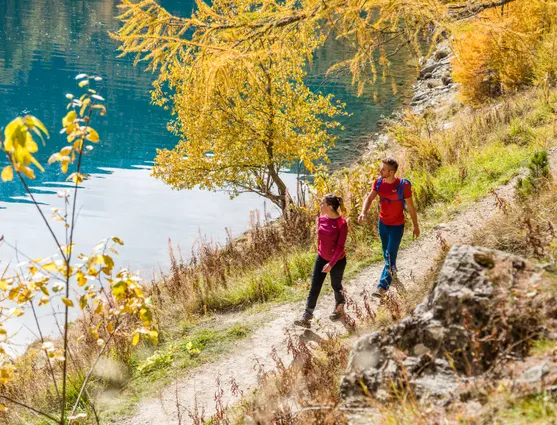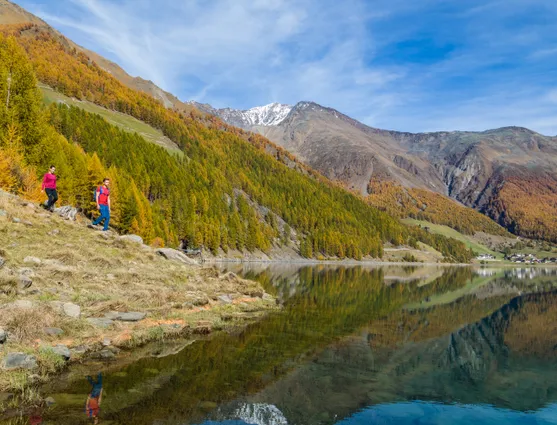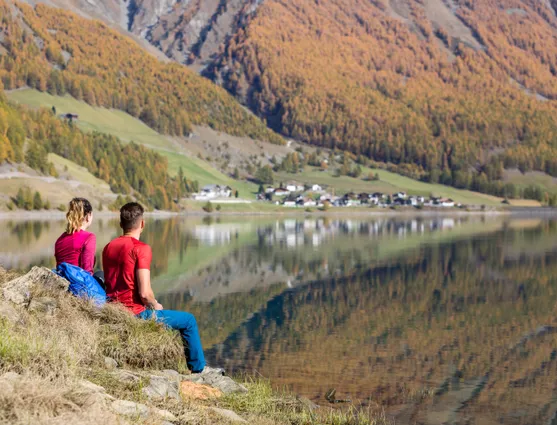
In autumn, my farmhands take every guest up to Vernagt once. Lake Vernagt lies there at 1,689 metres; the larch trees all around glow yellow and orange, and the water has that colour somewhere between emerald and turquoise, which never looks the same in a photograph as it does in real life. High above, the first snowcaps glisten on the Ötztal Alps. Anyone standing there thinks to themselves: it doesn’t get any more beautiful than this. As an old farmstead, this lake also reminds me of something else. I think of eight farmsteads that no longer exist. Please note: this story isn’t one from a glossy brochure. But it is true. And that’s why it belongs to the Schnalstal just as much as I belong to the Oberraindlhof.
What Lake Vernagt has swallowed up
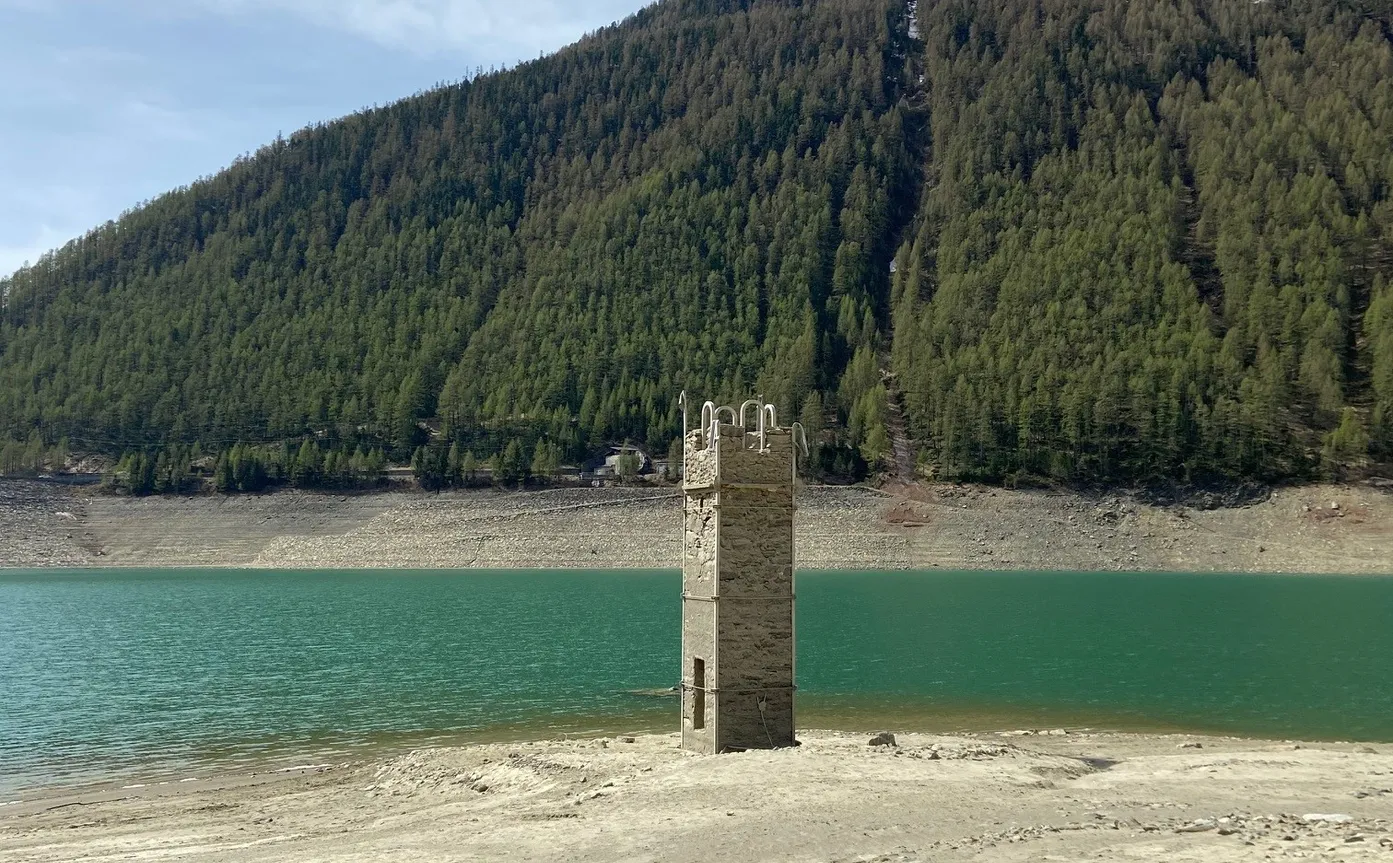
Once upon a time, there was a small hamlet with small farmsteads: Ober- and Unterörl with the single farmstead Nuihaus, Ober- and Untergamp, Ober- and Unterleit and the Spechtenhaus. In addition, there was the Leiterkirchlein, which the two Leithöfe farmsteads had endowed as a chapel in 1727. Later, a larger little church was added, and in 1820 the tower, which will be mentioned again. The hamlet was called Vernagt.
In the 1950s, the Etschwerke power companies from Bolzano and Merano began building a wall. 65 metres high. To hold back the water that was to be dammed there. And this water was then to flow down through a tunnel to Naturns to generate electricity – and the country was in desperate need of electricity after the war. On 31 July 1957, the last Mass was celebrated in the little church at Leiter. Then the water came.
Vernagt: What people in the valley don’t talk about
No one had asked for their opinion; facts were simply imposed: eight farming families had to leave. Some owned land elsewhere and were able to start afresh somewhere else. Others had nothing but the farmstead, which now lies at the bottom of the lake, and had to leave the Schnalstal. And some did not want to leave at all. They stayed, even as the water was already rising. How that turned out has long been a subject of silence here. I do not know whether out of shame or out of respect for the neighbours, or because people in the valley prefer to look forward rather than back.
As the Oberraindlhof, I’ve stood in my place since 1581 and know what a farm means to a family. It is a stable and a parlour, work and memories; it is the place where children learn to walk and the elderly pass away. The suffering of the people back then takes on a new urgency today. In many parts of this beautiful world, people and nature are being forced to make way: the appetite for electricity fuelled by new technologies is insatiable.
And even though this is not a cheerful story, I’d like to end on a positive note. With an invitation to visit us in the Schnalstal. If you click here, I’ll let you know where you can sleep particularly well.